


Wolfram
99 Case Studies
A Wolfram Case Study
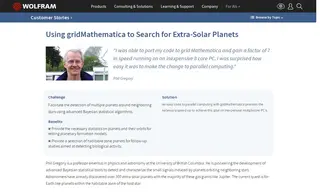
The University of British Columbia's Professor Phil Gregory needed to facilitate the detection of multiple extra-solar planets using advanced Bayesian statistical algorithms, a process that required immense computational power. The challenge was to run these complex models efficiently to test planetary formation models and identify habitable zone planets.
By implementing Wolfram's gridMathematica, the solution provided an easy route to parallel computing. This resulted in a speed-up factor of 7 on an inexpensive 8-core PC, which allowed for the simultaneous search for multiple planets. The measurable impact was a significant increase in research scope and complexity, including the discovery of three additional planets in a re-analysis of data from just four stars.
99 Case Studies