

MSC Software
152 Case Studies
A MSC Software Case Study
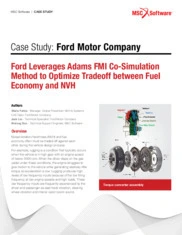
Ford Motor Company faced the challenge of balancing conflicting performance targets for fuel economy and noise/vibration/harshness (NVH) during vehicle design, particularly under lugging conditions. It was difficult to accurately determine the optimal torque converter slip speed to meet NVH targets without sacrificing fuel efficiency until late in the prototype stage, making changes expensive and time-consuming. They partnered with vendor MSC Software and its Adams product to find a solution.
MSC Software's solution utilized the Adams FMI co-simulation capability to integrate a 3D drivetrain model with a 1D converter slip controller model. This allowed Ford engineers to simulate various slip values and determine that 40 rpm was the optimal slip speed to meet NVH targets while achieving the best trade-off with fuel economy. The simulation results showed drastic reductions in steering wheel and seat track vibration, enabling Ford to optimize the torque converter design early in the development cycle.

Mario Felice
Manager, Global Powertrain NVH & Systems CAE Dept
152 Case Studies