

Fabric Genomics
5 Case Studies
A Fabric Genomics Case Study
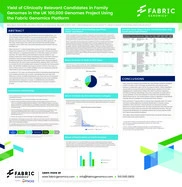
Genomics England, the UK organization behind the 100,000 Genomes Project, needed a scalable way to identify disease-causing variants in rare disease and cancer cases analyzed by whole-genome sequencing. To support this effort, Fabric Genomics provided its Opal Clinical platform as part of a clinical interpretation workflow designed to help prioritize variants and genes from complex family genomes.
Using Fabric Genomics’ VAAST and Phevor ranking algorithms alongside GeL’s tiering methodology, ClinVar, and expert review, the team analyzed 1,973 clinical cases and identified candidate causal genes/variants in 49.8% of them. Fabric Genomics also found that 23.0% of positive cases were detected only through the VAAST/Phevor top 20 rankings, improving yield by 9.4% overall and showing additional benefit in trio cases versus proband-only analyses.

Damian Smedley
Director of Genomic Interpretation
5 Case Studies