

Comsol
297 Case Studies
A Comsol Case Study
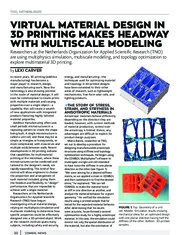
TNO, the Netherlands Organization for Applied Scientific Research, set out to develop virtual material design methods for multimaterial 3D printing and to make anisotropic, manufacturable microstructures usable in real products. Their challenge was to control stiffness and material orientation at the unit-cell level, combine different materials, and scale those micromodel results up to full-size devices while accounting for manufacturing constraints (e.g., powder removal and overhangs in SLM). To do this, TNO used Comsol and its Comsol Multiphysics software for multiphysics simulation, topology optimization, and multiscale modeling.
Using Comsol, TNO optimized single unit cells for targeted anisotropic stiffness, defined multimaterial cells and homogenized their effective properties, and ran coupled macromodel–micromodel simulations to design full devices. The workflow was validated with printed samples, applied to OLED electrode grids (yielding a 12% improvement in light homogeneity), and demonstrated end-to-end manufacturability via printable unit-cell libraries and a polymer hammer-handle prototype—showing Comsol enabled scalable, measurable gains from microlevel design to finished parts.

Erica Coenen
Research Engineer
297 Case Studies