

Altair (Siemens Xcelerator)
472 Case Studies
A Altair (Siemens Xcelerator) Case Study
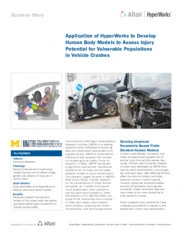
The University of Michigan Transportation Research Institute (UMTRI), a leader in vehicle injury biomechanics, needed parametric finite-element human body models that account for age, sex and BMI to better assess injury risk for vulnerable populations (children, small females, the elderly, obese). To address this gap, UMTRI used Altair’s HyperWorks tools—specifically HyperMesh and the HyperMorph morphing module—to develop and morph baseline whole‑body FE meshes into a wide range of anthropometries.
Using Altair HyperMesh/HyperMorph, UMTRI implemented a three‑step framework (statistical anthropometry, landmark‑based RBF mesh morphing, and stochastic material assignment) to rapidly generate morphed models for BMI targets (e.g., 25, 30, 35, 40) without re‑meshing. The Altair tools enabled mesh quality control and landmarking for a Taguchi‑based parametric study of 16 frontal‑crash simulations (48 km/h), which showed obese occupants experience larger excursions and significantly higher thoracic and lower‑extremity injury risk—demonstrating measurable capability for population‑based crash simulation to improve vehicle safety.

Jingwen Hu
Associate Research Scientis
472 Case Studies