

Siemens Healthineers
19 Case Studies
A Siemens Healthineers Case Study
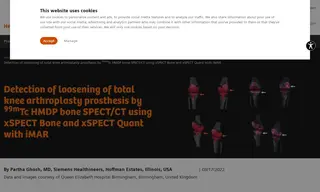
Queen Elizabeth Hospital Birmingham faced the challenge of diagnosing the cause of pain in a patient with bilateral total knee arthroplasty (TKA), as conventional X-rays were unremarkable. The hospital needed to accurately detect potential prosthetic loosening or infection. Siemens Healthineers addressed this challenge using their Symbia Pro.specta SPECT/CT system, employing a 99mTc HMDP bone SPECT/CT study.
The solution from Siemens Healthineers utilized advanced xSPECT Bone and xSPECT Quant reconstruction software combined with iterative metal artifact reduction (iMAR) on the CT images. This approach provided high-quality, artifact-free images that precisely localized focal hypermetabolism indicative of early prosthetic loosening in both knees. The results demonstrated a significant improvement in diagnostic accuracy and confidence, with quantitative SUV values helping to define the extent of the issue. Siemens Healthineers' technology enabled a clear and definitive diagnosis that was not possible with standard imaging.
19 Case Studies